Wing Fighter
- 4.4
- Rating
- 5.00M
- Installs
- Free
- Price
 Analysis by App-foxy
I went into Wing Fighter expecting a quick arcade shooter, and that is exactly where it works best: as a game I can open, play with one hand for a short stretch, and put down before it starts demanding too much attention. It is a free arcade title from MINIGAME ENTERTAINMENT LIMITED, built around aerial shooting and a roguelike-style run structure. The basic appeal is immediate, but the better surprise is how much of its identity comes from presentation. The aircraft, enemy formations, bright projectiles, and escalating danger all push toward the same fast, focused mood.
The game has reached over five million installs and sits at a 4.4 average from roughly 129 thousand ratings, so it is clearly not an obscure experiment. I can understand that reach. It offers a familiar mobile shooting format without requiring a long tutorial or a complicated explanation before the first battle. At the same time, it is not a perfect fit for everyone. Players who want a slow tactical game, a quiet story, or a completely purchase-free progression system may find the design less comfortable.
My first impression: quick to start, difficult to play casually
The first thing I noticed was how little resistance there is between launching the game and getting into the action. That matters for this type of arcade experience. A shooter like this lives or dies by its opening seconds: if the controls feel vague or the screen becomes unreadable, the whole idea loses its charm. Wing Fighter instead presents itself as a compact, energetic challenge. It wants me to watch the field, move the aircraft, avoid danger, and keep firing without pausing to manage a complicated interface.
You May Also Like

 Blood Strike: 2.5 Anniversary
Blood Strike’s Loadouts Turn Every Drop Into a Tactical Gamble
A close look at Blood Strike’s custom loadouts: how fast access to signature weapons reshapes its battle royale rhythm, rewards preparation, and narrows the gap between fights.

 Pandora - Music & Podcasts
Pandora’s Music Is Easy to Start, but Harder to Recover
Pandora’s strength is its low-effort path from a seed to a station. Its weak spot is how much confidence it asks you to place in connection, setup, and quiet recovery.

 8 Ball Pool
 Is Built on Rivalries, Rematches, and Routine
A close look at the rivalries, rematches, shared routines, and unanswered safety questions that turn a quick pool match into a persistent mobile community.

 Samsung Music
’s Quiet Strength Is Playing What You Already Own
Its reach comes less from spectacle than from dependable access to a personal library. That simplicity is both the app’s strongest retention engine and its ceiling.

 AccuWeather: Weather Radar
AccuWeather Review: A Quick, Clear Forecast for Everyday Decisions
For everyday plans, the best forecast is the one you can understand quickly. AccuWeather makes rain timing, radar, and local conditions easy to act on, with a few trade-offs.

 Hill Climb Racing
Why Hill Climb Racing Still Turns Crashes Into One More Run
A tiny car, a bumpy hill and one more upgrade: Hill Climb Racing keeps resurfacing because its simple chaos makes every near-miss feel personal.
More From Our News Desk



That simplicity should not be confused with ease. The early moments invite casual play, but surviving longer requires attention. Enemy movement, projectile patterns, and the pressure created by a crowded screen gradually turn a relaxed session into something much more deliberate. I found myself beginning a run with the thought that I would play for only a minute, then restarting because I wanted to improve the next attempt. That loop is one of the game’s strongest practical qualities.
The roguelike influence also changes how I judge failure. Losing a run does not feel exactly like losing a traditional arcade stage, because the attraction is partly in seeing how far a particular attempt can go and in making better choices along the way. The result is a good match for short breaks, waiting rooms, or a commute where I may not have time for a full campaign. However, it can become repetitive if I am looking for a large narrative journey rather than repeated attempts with changing pressure.
It is rated for Everyone, which makes the presentation approachable, but that does not mean every player will find the later action gentle. The visual style is colorful rather than grim, yet the concentration required can rise quickly. Younger players may enjoy the bright aircraft and effects, while parents should still remember that the game includes optional in-app purchases ranging from $0.99 to $99.99 per item. The free entry point is convenient, but the purchase range is worth keeping in mind before handing the device to a child.
A practical game for the gaps in the day
My most natural use case for Wing Fighter is a short session when I want active entertainment rather than passive scrolling. If I have ten minutes before an appointment, I can start a run, focus on the immediate threats, and stop without needing to remember a complicated plot. It also suits players who like trying to beat their own performance. The appeal is less about reaching a final cinematic conclusion and more about learning the feel of the battlefield and making the next attempt cleaner.
That said, I would not choose it for a relaxed evening when I want something calm. The constant movement and incoming hazards keep my attention engaged. It is also a poor match for anyone who dislikes repeating failed attempts. The game’s structure asks me to accept that some runs will end because I misread a pattern, moved too late, or became too confident. If that kind of repetition feels frustrating rather than motivating, a slower puzzle game would probably be a better alternative.
Art direction and setting: a bright language for aerial danger
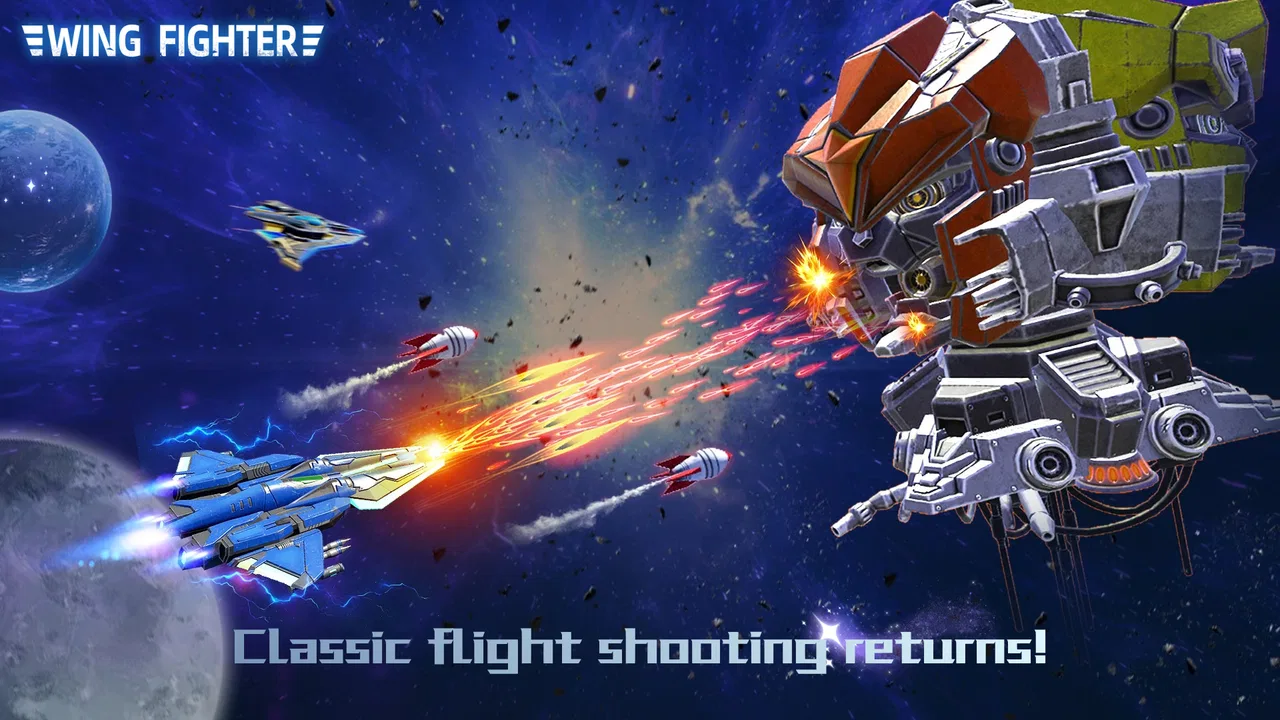
Wing Fighter communicates its setting mainly through visual shorthand. The aircraft, skies, enemies, and bursts of color create a recognizable aerial-combat fantasy without needing lengthy exposition. I do not have to study a map or read a large amount of text to understand the situation: I am in the air, threats are approaching, and survival depends on movement. That clarity is useful because the screen already has a lot to process.
The art direction favors readable impact over realism. This is not trying to reproduce the weight and technical detail of a flight simulator. Instead, the plane functions as a clear player marker, while enemy attacks become visual warnings that I need to interpret quickly. The exaggerated effects help the game feel lively, although they can also become busy when several attacks overlap. In those moments, the presentation supports the arcade mood but demands that I learn which visual signals deserve immediate attention.
I like the way the setting supports the mechanics rather than competing with them. The sky is not just background decoration; it gives the action a sense of open space and forward motion. The aircraft’s position remains central, and the surrounding effects make every movement feel consequential. Even when the underlying activity is familiar, the visual framing keeps it from feeling like a collection of disconnected menus and targets.
There is a trade-off here. Players who want detailed aircraft simulation, realistic historical environments, or a strong character-driven world will not find that experience in this game. Its world is designed to establish mood quickly, not to invite slow inspection. I see that as an intentional limitation rather than a flaw, but it is important when comparing it with more elaborate flight or story games.
Why the visual clarity matters during a run
One useful habit is to watch the spaces between threats rather than stare only at the aircraft. When the screen fills with projectiles, the safest route is often identified by the empty lane that is about to close, not by the enemy that is currently closest. Wing Fighter’s colorful presentation makes those openings visible, but only if I resist the temptation to focus on firing alone. The game rewards scanning the whole field.
I also found that the art style affects how I handle mistakes. Because the game uses a bright, energetic look, failure feels more like a sharp interruption than a dramatic defeat. That keeps the mood light enough for quick retries. The downside is that a run can sometimes feel visually intense before I have fully understood why it ended. Taking a moment to identify the attack pattern is more useful than immediately blaming the controls.
Sound and rhythm: the mood comes from constant forward pressure
The game’s sound and visual effects work together to keep the action moving. I experience each run as a rhythm of approach, avoidance, firing, and recovery. Even without turning the session into a long play period, the game creates a sense that something is always arriving. That continuous pressure is central to its identity: the atmosphere is not peaceful flight but controlled panic at an arcade scale.
This rhythm also helps explain why the game feels more engaging than a simple target shooter. I am not merely waiting for enemies to appear. I am responding to a sequence of threats while trying to preserve a useful position. The sound and bursts of on-screen action give those moments a pulse, making a successful dodge feel like part of a larger flow. When I break that flow by moving too aggressively, the run often becomes harder to recover.
For short sessions, this is effective. I can pick up the phone and immediately enter the game’s mood without needing a long setup. For extended sessions, however, the same intensity can become tiring. The game does not seem designed to be background entertainment while I watch something else. It asks for visual concentration, and the sound design reinforces that demand. Players who prefer low-pressure mobile play should approach it in small portions.
A practical tip is to treat the audio-visual feedback as a timing aid rather than decoration. When an attack arrives, the important question is not simply whether I can destroy it, but whether my movement is keeping pace with the rhythm of the encounter. Firing continuously while drifting without a plan is less effective than maintaining a stable route and making small corrections. That change in mindset made my runs feel more controlled.
Mechanical fit: where the roguelike arcade formula succeeds
Wing Fighter’s strongest mechanical decision is combining straightforward air shooting with repeated runs. The arcade foundation makes it easy to understand, while the roguelike structure gives each attempt a reason to continue. I am constantly balancing immediate survival against the desire to see what comes next. That tension is more compelling than a simple sequence of identical stages because every mistake can teach me something about positioning and timing.
The game is best when I focus on movement discipline. It is tempting to chase every target or drift toward the most rewarding-looking part of the screen, but survival usually depends on preserving room to react. Staying near a useful area of open space gives me more options when attacks overlap. This is one of the less obvious lessons of the game: aggressive movement can look productive while quietly removing the escape routes needed a few seconds later.
Another useful approach is to make decisions before the screen becomes crowded. If I wait until several threats are already close, I am forced into emergency movement and may collide with danger while trying to avoid something else. Watching the edges of the play area and anticipating where the next pressure will come from makes the action feel less random. The game remains fast, but it becomes more readable once I stop reacting only to what is directly in front of me.
The roguelike format also creates a clear trade-off between experimentation and consistency. Trying a different approach can reveal a better way to handle a difficult sequence, but repeating the same safe habits helps me build reliable muscle memory. I prefer to experiment early in a session and then settle into a steadier style when I reach a promising run. That workflow is more satisfying than treating every attempt as an identical challenge.
Progression, spending, and the question of fairness
The game is free to download and play, which makes testing it straightforward. Its optional purchases are part of the overall design, though, and the listed price range extends from small impulse buys to much more expensive individual items. I would advise setting a personal spending limit before getting invested in repeated attempts. The desire to improve after a frustrating loss can make any arcade game more tempting than expected.
For me, the best way to judge the experience is to first play without assuming that every obstacle should be solved by spending. The core appeal is learning patterns, improving movement, and making better choices during a run. If a player is uncomfortable with purchase prompts or dislikes progression systems that may encourage extra spending, this is a meaningful reason to choose a different arcade shooter.
The current version is 1.7.790, and the game supports devices running Android 7.0 or later. That gives it a relatively broad reach for Android users, although compatibility alone does not guarantee that every phone will display busy action equally well. On a smaller screen, visual effects and incoming projectiles may compete for attention. I would personally test the controls and readability before committing to long sessions, especially if precise movement matters to my enjoyment.
Compared with a traditional arcade shooter, Wing Fighter offers more reason to replay a run because of its roguelike framing. Compared with a deeper roguelike, it is faster to understand and more focused on immediate reflexes than on lengthy planning. That middle position is its main advantage. It is a good choice for someone who wants more variety than a fixed shooting gallery but less complexity than a large strategy-heavy roguelike.
Who should play it, and who should skip it
I would recommend it to players who enjoy colorful aerial action, repeated attempts, and the satisfaction of gradually reading enemy pressure more accurately. It is particularly suitable for people who want a game that can be played in short bursts but still offers enough challenge to justify returning. The combination of accessible presentation and demanding attention gives it a useful place between casual time-killers and more serious action games.
I would skip it if I wanted realistic flight controls, a substantial story, or a slow progression path where every session feels calm and predictable. I would also be cautious if I strongly dislike in-app purchases, because the presence of optional items can affect how comfortable the free experience feels. Players who prefer competitive multiplayer may want something built around direct human opponents instead; Wing Fighter’s appeal is centered on its own action loop rather than social competition.
It is also worth considering how much visual stimulation I enjoy. The same bright effects that make the game exciting can make a crowded encounter harder to parse. If I am sensitive to fast flashing action or prefer a minimalist screen, this may not be the most comfortable arcade option. In that case, a simpler shooter with fewer simultaneous effects would likely be a better fit.
Atmosphere verdict: a focused arcade mood with real limits
After spending time with Wing Fighter, I see its greatest success in the way its art, sound, setting, and pacing point in the same direction. The game feels like an aerial arcade challenge from the moment the run begins. The bright visual language makes the action approachable, the sound supports forward momentum, and the roguelike structure gives each attempt a reason to continue. None of those parts needs to overpower the others, which keeps the experience coherent.
Its limitations are equally clear. The intensity can become tiring, repeated runs will not satisfy everyone, and the purchase range means free access does not remove every concern. It also does not try to be a flight simulator or a story-rich adventure. I think it is better to approach it as a compact reflex game with a strong visual mood, not as a complete replacement for every other type of mobile action game.
For my own use, I would keep it installed for those moments when I want immediate action and a challenge that rewards concentration. I would play in short sessions, pay attention to open escape lanes, and avoid treating every failed run as a reason to spend. That combination lets the game’s best qualities stand out without ignoring its friction.
My final recommendation is simple: try Wing Fighter if you want colorful roguelike air shooting that gets moving quickly and makes short breaks feel active. The free entry point and Everyone rating make it easy to sample, while the 4.4 average and millions of installs reflect its broad appeal. Just remember that its real test is not the first easy run; it is whether you enjoy learning from repeated pressure once the screen becomes demanding. For players who like that rhythm, it is a lively and coherent arcade game. For everyone else, the same intensity may be the reason to look elsewhere.
FAQs for Wing Fighter
01What is Wing Fighter and what makes it unique?
Wing Fighter is a fast-paced arcade shooting game designed for both Android and iOS platforms. Unlike traditional shooters, it combines captivating graphics with dynamic gameplay, offering a range of customizable fighter jets and weapons. The unique power-up system and challenging boss battles set it apart, providing an engaging experience for players of all skill levels.
02Are there in-app purchases in Wing Fighter?
Yes, Wing Fighter includes in-app purchases. Players can buy various items, such as upgrades for jets, exclusive skins, and additional power-ups. While the game is free to download and play, these purchases can enhance the experience and accelerate progress. However, they are entirely optional, and players can enjoy the game without spending money.
03What are the system requirements for Wing Fighter?
To run Wing Fighter smoothly, Android users need a device running version 5.0 or higher, while iOS users require iOS 10.0 or later. The game demands moderate processing power, so newer devices will provide the best experience. It's advisable to have at least 1GB of free space to ensure optimal performance and to accommodate future updates.
04Is Wing Fighter suitable for children?
Wing Fighter is rated for players aged 10 and older due to its mild fantasy violence. The game involves shooting enemy aircraft and avoiding obstacles, which may not be suitable for younger children. Parents are encouraged to review the game content and assess whether it aligns with their values and their child's maturity level.
05Does Wing Fighter require an internet connection to play?
Wing Fighter primarily requires an internet connection for downloading updates and accessing certain features, such as leaderboards and multiplayer modes. However, the core gameplay can be enjoyed offline, making it convenient for users who have limited internet access or prefer to play without connectivity.
Pros
- Intuitive controls make it easy for beginners.
- High-quality graphics enhance gameplay immersion.
- Diverse missions keep the game engaging.
- Regular updates add new features and content.
- Multiplayer mode enhances competitive play.
Cons
- In-app purchases can be quite costly.
- Requires a stable internet connection.
- Occasional lag on older devices.
- Limited offline gameplay options.
- Ads can interrupt the gaming experience.

Wing Fighter
Gallery